


Contentrain
AI-native content governance ecosystem. Contentrain lets teams extract, govern, and ship structured content straight from their codebase — a local-first, Git-native toolchain (CLI, MCP server, type-safe SDK) plus Contentrain Studio, a conversation-first, self-hostable CMS.
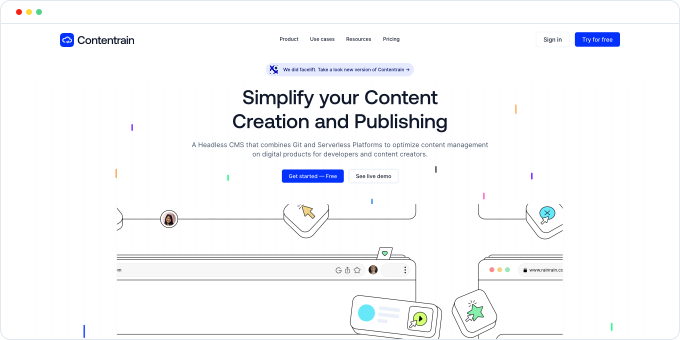
The Challenge
AI made teams dramatically faster at producing code — but it did nothing for the content trapped inside that code. UI copy, docs, and structured content stay hardcoded across components: unstructured, untranslated, and ungoverned. Traditional CMS products answer this by hiding content behind opaque databases and admin panels, and by locking it into a proprietary runtime. The brief was to let AI agents extract, create, translate, and update content at full speed, while keeping schema, human review, and portable output firmly in control — with no vendor lock-in.
Our Solution
We designed and built Contentrain as a two-layer, open ecosystem around a single `.contentrain/` Git contract — plain JSON and Markdown that any framework or language can read. Contentrain AI (MIT, local-first): a CLI plus a deterministic MCP server (17 tools over stdio and HTTP, with Local, GitHub, and GitLab providers), a type-safe `#contentrain` query SDK, and a library of agent rules and skills. Agents extract hardcoded strings and create, translate, and update content; Contentrain enforces the schema, writes canonical output, and routes every change through Git-native review branches. It is agent-agnostic (Claude Code, Cursor, Windsurf, VS Code, Copilot) and ships starters for Nuxt, Next.js, Astro, SvelteKit, and VitePress. Contentrain Studio (open-core, AGPL + EE): a conversation-first, Git-backed content operations platform built on Nuxt 4. Teams connect a repository, define models, edit through chat, forms, or a structured UI, review changes as branches, commits, diffs, and merges, and deliver through media, CDN, and APIs — self-hosted or as a managed Pro/Enterprise offering, with Git always the source of truth.
Technologies
Results
Shipped as an open ecosystem rather than a single product: the MIT npm packages (the `contentrain` CLI, `@contentrain/mcp`, `@contentrain/query`, `@contentrain/rules`, `@contentrain/skills`, and `@contentrain/types`) with 15 reusable agent skills, alongside the AGPL open-core Studio platform and a managed cloud option. Content stays portable JSON and Markdown in Git with zero vendor lock-in — and this very site runs on it.
Related Work
Yanyana
Social game platform for weddings, corporate events, and social gatherings. Supports P2P offline (2-10 players) and online event (50-500+ players) modes across Web (PWA), iOS, and Android. Built with React Native (Expo + CLI), Bun.js + ElysiaJS, Vue 3, and a pnpm workspaces monorepo with 4 apps + 4 shared packages. Features 12+ independent game engines, real-time WebSocket state sync, 39 shared Vue components as a design system, dual payment system (Paddle + In-App Purchase), and 130+ test files with 500+ tests including Stryker mutation testing.
LineDiff
AI-powered text and document comparison platform. Local-first, offline-capable with client-side encryption for privacy. Supports 10+ file formats including txt, docx, pdf, json, xml, csv, md, html, and yaml. Built with Nuxt 4 + Vue 3, Firebase Firestore, and OpenAI API. Features IndexedDB primary storage with Firestore sync queue (local-first architecture), Web Workers for diff computation, Paddle subscription management, and integrations with Google Docs, Notion, and MS Word Add-in.
Visivi
Visivi is an HR platform with both mobile and web portals. We developed the mobile application with React Native, making it cross-platform for both iOS and Android. For the web portal, we used Nuxt.js and Vue.js.